
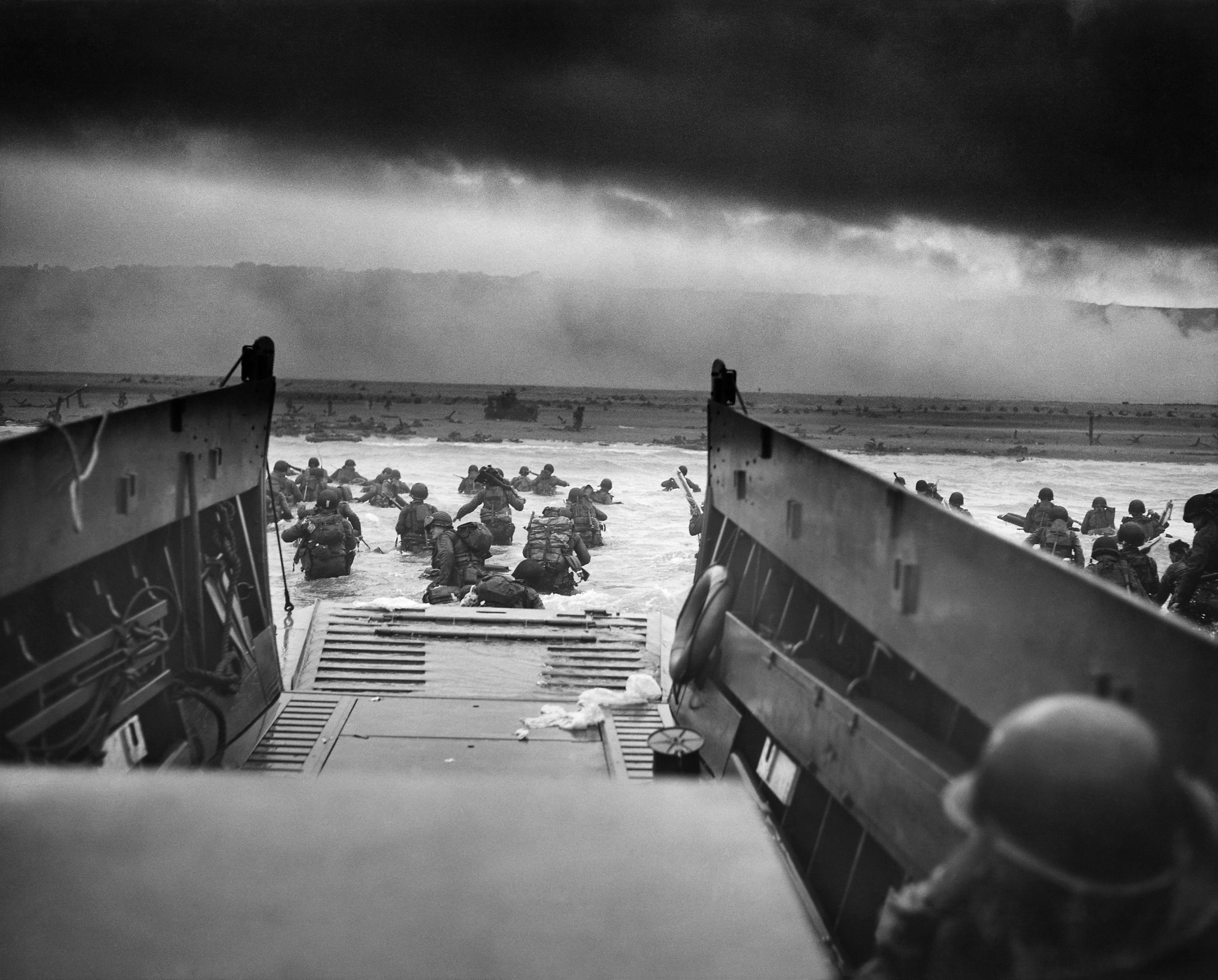
On June 6, 1944, allied forces stormed the beaches of Normandy, France. One of the hardest hit units was the 116 infantry regiment of the American 29th Infantry Division. They landed on Omaha Beach in the first wave of landing craft. David Silva was a 19-year-old infantryman in the 29th Division. When the ramp dropped on his landing craft, he struggled to wade ashore under the nearly 60 pounds of equipment strapped and slung across his body. In short order, he was hit three times in the chest by machine gun fire from the ridge overlooking the beach. Heinrich Severloh was manning a machine gun on the ridge as part of the German 352nd Infantry Division, firing at the soldiers making their way ashore.
Twenty years after the war, Severloh contacted Silva after seeing his name in the book, The Longest Day, a book about D-Day written by Cornelius Ryan. Severloh wanted to meet someone who charged the beach that morning in his sector. Eventually, the two men met in person, and after discussing their experiences that June morning, they came to realize that Severloh was the machine gunner who shot Silva. It was obvious to Silva that Severloh was deeply disturbed by the fact that he had shot Silva and many other allied soldiers, many of whom died on the beach that morning. In that moment of recognizing the guilt Severloh was experiencing, Silva looked Severloh in the eye and told him that he forgave him. Just a few simple words. “I forgive you,” but words filled with power and purpose.
Nearly 60 years after the war, they met again, This time on the beach where they were opposing combatants and no more than boys. At that meeting, Severloh said, “There was no glory on the beach that morning. Just a lot of blood, and screaming, and young men dying. With Silva, you can apologize, the others who died out there, you can no longer apologize,…..I visit them in the cemetery…..we were all just boys”.
If there is anything you can be certain about, it is that David Silva has never forgotten the horrific sights and sounds of battle, the smell of death, the cries of anguish, and the gore of broken bodies of friends and comrades that permeated Omaha Beach that day. He never forgot the pain of his own wounds, both physical and psychological. The three round scars on his chest remind him of that day every time he takes off his shirt. He has not forgotten, but he has forgiven.
Heinrich Severloh has also not forgotten that day. The vision forever burned into his brain is one of men dropping into the surf and sand, their only movement coming from the relentless waves rolling their lifeless bodies back and forth. Each memory is filled with the foaming sea turning a deeper shade of red with each pull of the trigger on his MG42 machine gun. It is forever burned not only into his brain but into his heart. He has not forgotten. The small bit of relief he has from that day is that David Silva forgave him. Yet no matter how often he visited the cemeteries in Normandy, he could not find absolution from the dead. He was a man living his life in need of forgiveness.
Forgiving and Forgetting is Not How It Works
Nobody would expect David Silva to forget what happened to him or many of his buddies on Omaha Beach that day. But that is what makes the forgiveness between David Silva and Heinrich Severloh all the more powerful and all the more Gospel-like in its application. It mirrors the forgiveness we see Jesus offering time and again in the Scriptures.
So often, people say they can forgive, but they can’t forget. That is usually code for, “I know I am supposed to say the words ‘I forgive you,’ but I am still going to hold onto the hurt and hold this over you when it suits me.” It usually means I have my eye on you, and I am just waiting for you to mess up again. Or, I may not be seeking revenge, but I would certainly not shed a tear if something bad happened to you. It is an indicator that the relationship is never really going to experience reconciliation. There is always the possibility of the feelings and the memories being trotted out again and thrown in the face of the offender. At the very least, there is a noticeable breach in the relationship that never heals, all because we allow feelings to dictate our actions instead of the truth of the Gospel and the call from Christ to forgive as we have been forgiven.
Sometimes when people say they can forgive but they can’t forget, it means they are saying, “It still really hurts, I still remember vividly what they did to me and I can’t let go it”. You may not have any feelings or thoughts of wanting to get back at them, but because you still remember the pain, you think there is something deficient in your forgiving.
We need to understand forgiving is not the same as forgetting, and remembering the pain of a past hurt does not necessarily mean you have not been able to forgive someone. In fact, the case will be made later in this chapter that if you have forgotten what was done to you, then you are actually incapable of forgiving. If you have no recollection of being wronged, then there is no way for you to forgive someone. Forgiveness takes for granted that you have, in fact, remembered the wrong done to you, but you respond by forgiving.
We see what forgiveness can look like in the experience of Silva and Severloh. But what is forgiveness really? If you are David Silva, how do you find the strength to forgive? If you are Heinrich Severloh, how do you find the courage to ask for and then accept forgiveness? Where does forgiveness fit in the whole scheme of the cosmos, and why did Jesus have to die to make it possible? Why couldn’t God just call it even and forgive everyone? Oh, and by the way, we are all both David Silva and Heinrich Severloh at the same time, needing to forgive and in need of forgiveness.
 The Provocative Christian